From Medicine to Canvas: Neerja Chandna Peters' Geometric Language of Healing
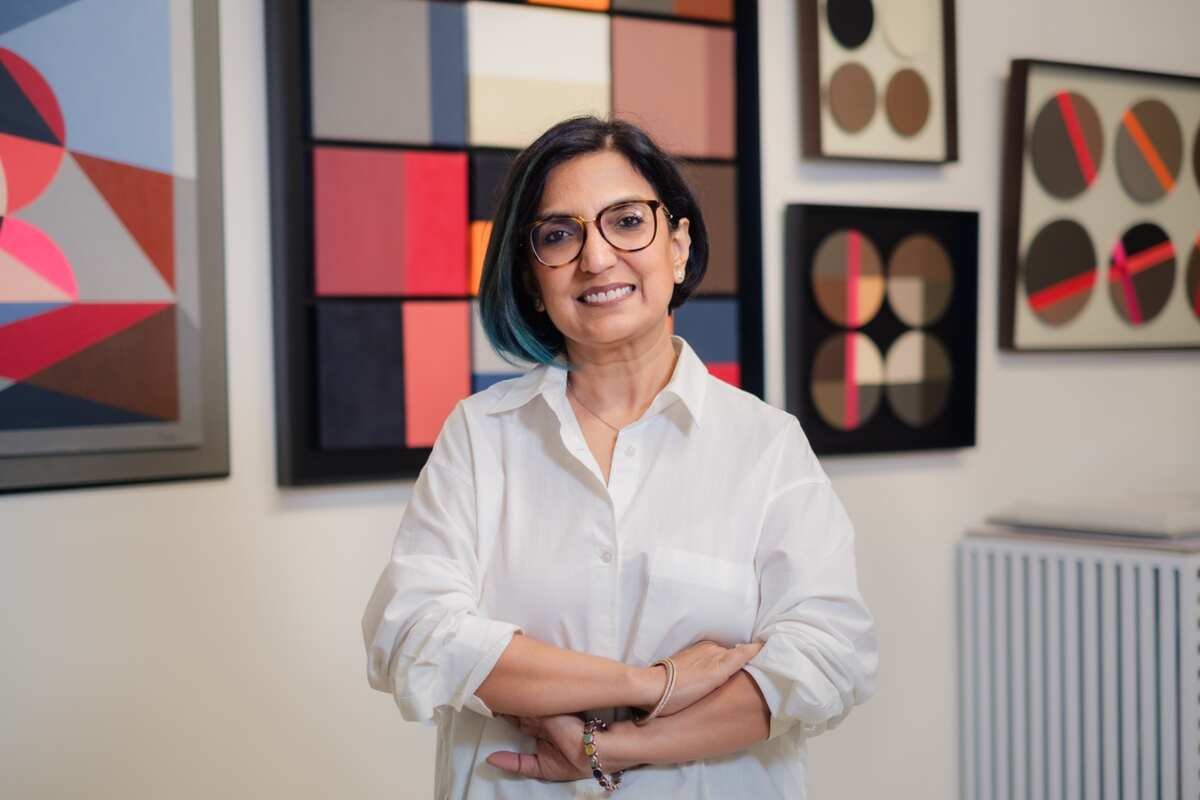
For Neerja Chandna Peters, geometric form transcends mere visual structure to become a vocabulary of contemplation, restoration, and self-examination. Her canvases are characterized by exacting angles, balanced proportions, and careful composition, yet within this rigorous framework pulses a narrative that is intensely intimate—one shaped by a career spanning both scientific medicine and artistic creation.
Peters trained as a physician before committing fully to her painting practice. Her path between these two disciplines was not abrupt but rather an organic progression. Artistic impulses had always inhabited her world—through written expression, drawings, needlework, and the technical precision required in studying human anatomy. Painting, however, unlocked something more profound: a space demanding silence, complete engagement, and deep introspection.
In her compositions, interlocking triangles and angular planes converge with deliberate precision, immediately engaging viewers through their mirrored arrangement. The visual architecture feels almost structural in its careful calibration of scale and recurring motifs. Yet this formal rigor resists any sense of coldness. Instead, the forms seem to possess their own vitality—expanding, shifting, alive with movement.
The central arrangement remains intentionally open to interpretation. Depending on one's gaze, the composition might resolve into a visage, a protective mask, a winged form, or a spiritual symbol. This deliberate multiplicity sits at the heart of Peters' artistic method. Rather than fixing meaning, she constructs spaces where perception transforms through sustained attention. The viewer becomes an essential collaborator, finding shape through meditative looking. In this framework, her abstraction operates not as detachment but as lived experience.
Color amplifies this dynamic engagement. Vibrant magentas, crimsons, oranges, and golden hues vibrate against quieter greys, deep blacks, and restrained teals. This chromatic tension articulates an ongoing conversation between passion and moderation—mirroring the spectrum of human existence encompassing both ecstasy and sorrow, turbulence and repose, comprehension and doubt. For an artist whose professional past involved witnessing human fragility, perseverance, and the processes of mending, such emotional complexity feels entirely natural.
Peters frequently describes her artistic practice as both therapeutic and spiritual. Both the act of creation and the experience of encountering her work function as processes of renewal. Within a world characterized by constant stimulation and accelerating demands, these paintings provide a sanctuary for quiet reflection. The symmetrical elements suggest harmony and alignment, yet this equilibrium remains dynamic rather than static—perpetually adjusted, much like the emotional landscape of lived experience.
Her transition from medical practice permeates every aspect of her artistic vocabulary. The methodical exactness of her medical training remains evident in the careful articulation of each form, while the compassionate awareness developed through years of patient care manifests in the contemplative stillness radiating from her work. She has not abandoned healing; rather, she has reimagined it—reshaping it into a practice grounded in visual inquiry and spiritual anchoring.
Peters has achieved international standing in the art world, mounting solo exhibitions including a presentation at New England Regional Art Museum in Australia, where she also served as artist in residence. Her participation extends to the 4th Australian Biennale of Reductive Arts as well as the 8th International Biennale of Non Objective Arts. Her paintings continue to resonate with viewers through a visual language that merges mathematical precision with intuitive sensitivity.
Within this work, and across her broader body of painting, geometry functions as extended metaphor. Each triangular form, each reflected plane, each carefully drawn boundary participates in a larger contemplation on transformation and becoming. The paintings embody a vision that recognizes structure and letting go, systematic thinking and creative spontaneity, not as opposing forces but as complementary elements. Through her abstract language, Peters demonstrates that restoration emerges not solely from medical intervention, but equally through the quiet, profound transformation that art alone can offer.
Compare options