Renowned Palaeontologist Steve Brusatte Engages Ashoka University Students on Dinosaur Evolution
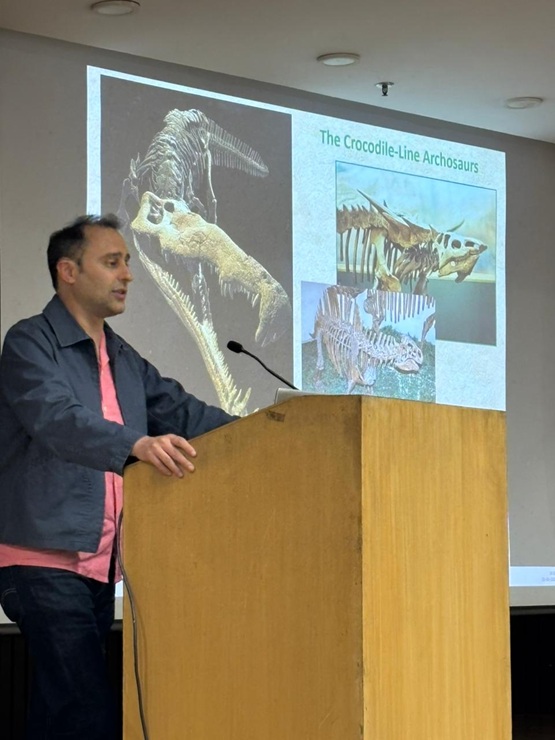
Ashoka University in New Delhi recently welcomed Professor Steve Brusatte, a distinguished palaeontologist and bestselling author, for an interactive session examining the evolutionary history of dinosaurs. The event, organised under the Lodha Genius at Ashoka University initiative, featured a presentation titled "The Rise and Fall of the Dinosaurs," drawing from Brusatte's acclaimed book.
Based at the University of Edinburgh as a Professor of Palaeontology and Evolution, Brusatte has established himself as a leading figure in understanding how dinosaurs, mammals, and birds developed over time. His scientific contributions include the discovery and naming of more than a dozen prehistoric species, along with over 150 peer-reviewed publications and multiple bestselling works. Among his numerous accolades are fellowships from the Royal Society of Edinburgh, the Blavatnik Awards for Young Scientists, the UK Life Sciences Laureate designation, and the Paleontological Association President's Medal.
During his presentation, Brusatte traced dinosaur development across more than 230 million years, from their initial emergence to their peak dominance and ultimate disappearance following an asteroid strike. He underscored how ongoing fossil discoveries continue to transform scientific understanding of Earth's biological history, while also demonstrating how combining traditional fieldwork with contemporary tools—including advanced imaging and computational modelling—is revolutionising paleontological research.
Speaking to the assembled students, Brusatte highlighted the explosive growth in the field: "We're in a remarkable period for palaeontology, with approximately 50 new dinosaur species identified annually—nearly one per week—by young researchers making discoveries worldwide. India represents an extraordinary opportunity that remains largely unexplored. The subcontinent hosts some of the earliest dinosaurs from the Pangea era alongside some of the largest species ever documented, such as Rajasaurus. The potential for further discoveries here is immense. I encourage India's young people to pursue this field."
He further noted that entry into paleontology does not require advanced credentials: "You don't need to be a professor or hold a PhD. What matters is inquisitiveness, determination, patience, and intellectual openness. You might be surprised by what you uncover."
Somak Raychaudhury, Vice-Chancellor of Ashoka University, reflected on the significance of such engagement: "Hosting Professor Brusatte allows us to introduce our students to his work. Paleontology's particular strength lies in its interdisciplinary nature—bridging geology, biology, and data science while demanding both meticulous fieldwork and analytical rigour. Exposing students to such fields cultivates the capacity to think across different timescales and systems, fostering the kind of intellectual curiosity essential for developing future scientists and researchers."
Lodha Genius at Ashoka University, initiated in 2023, functions as a collaborative venture between the Lodha Foundation and the university. The comprehensive programme targets high-achieving students from Grade 9 onwards and provides complete financial support throughout a multi-year curriculum. Participants benefit from intensive academic engagement, personalised mentoring, practical learning opportunities, and access to conversations with prominent figures in science, academia, and business.
Compare options